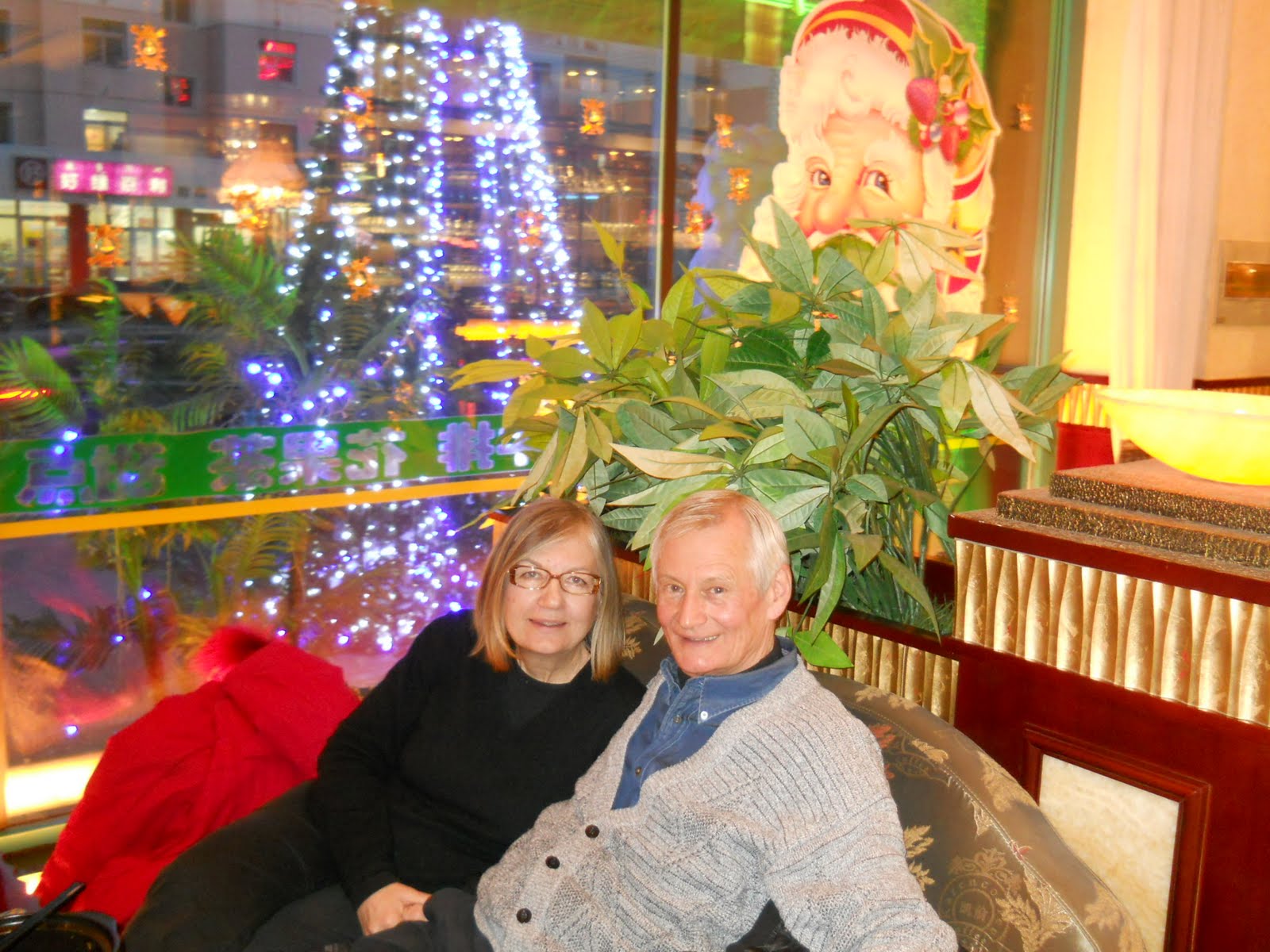
Our first semester of teaching of teaching is over and we're looking forward to some sight-seeing.
 Teacher Johnson says goodbye to students at class party.
Happy 2011!
 Don't let the sunny grasslands and blue skies fool you -- it's cold (-25 Celcius) in Inner Mongolia.
 So we bundled up and went sliding; Diane's on the tow rope on her way up the hill of artificial snow.
Winter in Baotou -- cold (-15 Celsius), often sunny, and no snow.
 The horse, an integral figure in the creation and survival of the Middle Kingdom, is frequently depicted in public places like this Culture Park.
 Behind the mop, whether on the street or at home. Sigh.
In the Communist era dogs were more likely to be herders, guards, or meals than companions. Now, not only are they more common, but their role has changed.
 This is as close as we've seen to our favorite dachshund breed, and he was just as fixated on the tennis ball being thrown as ours are. We often see older people taking a walk with their dog, a reflection of dogs' important role as companions as the nest empties.
 While we haven't noticed a great variety in breeds, most look like this guy. Since Pekingese date from the 700s when Chinese emperors made them the palace dog, this may account for their appearance.
 Since dogs, like people, are numerous here, regulations are coming into place. Beijing limits city dogs to no more than 35 cm (14") in height, and Shanghai is planning a one-dog-only policy. A formal proposal to ban the eating of dogs has been introduced to the National People's Congress.
  With dogs have come services for dogs with dog-treat stores, dog social networking, and more vets. Breeds like huskies and poodles are status symbols, and with colder weather now we've even seen dogs wearing little sweaters.
 So it's a dog's life here, as this little guy sunning himself would agree. And a real visible testimony to the increasing affluence in China.
Baotou Teachers' College is part of the Inner Mongolia University of Science and Technology. About 10,000 students study to be teachers with majors ranging from physics to physical education; we teach the English majors.
 It's a modern campus with labs, administration, fine arts buildings, two large cafeterias where we enjoy great food, and many dormatories since all students live on campus.
 This is the old teaching building where we have our classes; a new building is under construction, as are apartments for all the foreign teachers.
Hohhot, capitol city of the province of Inner Mongolia, was the spot for a weekend visit.
 We boarded the train at the Baotou station for the 2 1/2 hour journey. Train travel is quick, cheap (about $2 for our trip) and very crowded. We've learned that as soon as the gates open there's a great surge and scramble for seats.
 We met up with a couple of other Amity teachers to see the sights and compare notes on the joys and challenges of teaching in China.

 Baotou's first Walmart just opened in a new downtown shopping center; it's one of their almost 200 stores in China.
 We enjoyed the first real snowfall here, so finally have some white fluffy stuff to go with the cold weather.
 We'll be traveling over the winter holiday (Beijing, Xi'an, Hong Kong, Hanoi) and look forward to celebrating the Chinese New Year, the Year of the Rabbit.